
recherche

0
Posted on 19:55 by The Wonders Of The World and filed under

LONDON - Lucy Vodden, who provided the inspiration for the Beatles' classic song "Lucy in the Sky with Diamonds," has died after a long battle with lupus. She was 46.

Her death was announced Monday by St. Thomas’ Hospital in London, where she had been treated for the chronic disease for more than five years, and by her husband, Ross Vodden. Britain’s Press Association said she died last Tuesday. Hospital officials said they could not confirm the day of her death.

Vodden's connection to the Beatles dates back to her early days, when she made friends with schoolmate Julian Lennon, John Lennon's son.


Julian Lennon, then 4 years old, came home from school with a drawing one day, showed it to his father, and said it was "Lucy in the sky with diamonds."


At the time, John Lennon was gathering material for his contributions to "Sgt. Pepper's Lonely Hearts Club Band," a landmark album released to worldwide acclaim in 1967.


The elder Lennon seized on the image and developed it into what is widely regarded as a psychedelic masterpiece, replete with haunting images of "newspaper taxis" and a "girl with kaleidoscope eyes."


Rock music critics thought the song's title was a veiled reference to LSD, but John Lennon always claimed the phrase came from his son, not from a desire to spell out the initials LSD in code.


Recent reunion

Vodden lost touch with Julian Lennon after he left the school following his parents' divorce, but they were reunited in recent years when Julian Lennon, who lives in France, tried to help her cope with the disease.

He sent her flowers and vouchers for use at a gardening center near her home in Surrey in southeast England, and frequently sent her text messages in an effort to buttress her spirits.

"I wasn't sure at first how to approach her," Julian Lennon told the Associated Press in June. "I wanted at least to get a note to her. Then I heard she had a great love of gardening, and I thought I'd help with something she's passionate about, and I love gardening too. I wanted to do something to put a smile on her face."

In recent months, Vodden was too ill to go out most of the time, except for hospital visits.

She enjoyed her link to the Beatles, but was not particularly fond of "Lucy in the Sky with Diamonds."

"I don't relate to the song, to that type of song," she told the Associated Press in June. "As a teenager, I made the mistake of telling a couple of friends at school that I was the Lucy in the song and they said, 'No, it's not you, my parents said it's about drugs.' And I didn't know what LSD was at the time, so I just kept it quiet, to myself."

Young deaths

Vodden is the latest in a long line of people connected to the Beatles who died at a relatively young age.

The list includes John Lennon, gunned down at age 40, manager Brian Epstein, who died of a drug overdose when he was 32, and original band member Stuart Sutcliffe, who died of a brain hemorrhage at 21.

A spokeswoman for Julian Lennon and his mother, Cynthia Lennon, said they were "shocked and saddened" by Vodden's death.

Angie Davidson, a lupus sufferer who is campaign director of the St. Thomas' Lupus Trust, said Vodden was "a real fighter" who had worked behind the scenes to support efforts to combat the disease.

"It's so sad that she has finally lost the battle she fought so bravely for so long," said Davidson.

Copyright 2009 The Associated Press. All rights reserved. This material may not be published, broadcast, rewritten or redistributed.


0
Posted on 19:52 by The Wonders Of The World and filed under


0
Posted on 19:49 by The Wonders Of The World and filed under


Lucy Vodden, the woman who inspired the Beatles song “Lucy in the Sky with Diamonds,” died last Tuesday at the age of 46.


Vodden’s death, after a long battle with Lupus, was announced on Monday by the St. Thomas Hospital in London, where she was being treated.


Vodden, who’s maiden name was O’Donnell, was a childhood friend of John Lennon’s son, Julian. After painting a picture of her with diamond-shaped eyes, young Julian brought the drawing home from school, and told his dad, “That’s Lucy in the sky with diamonds,” inspiring the song which appeared on the 1967 album, “Sgt. Pepper’s Lonely Hearts Club Band.”

Many have speculated that the song is a reference to LSD, however, the Beatles, who admitted to using the drug around that time, never confirmed the rumor.


Julian Lennon had been in contact with Lucy in recent years, supporting her through her illness.

0
Posted on 03:00 by The Wonders Of The World and filed under


The fortress of Sacsahuaman was built by the Inca in the 15th century on a hill northwest of their capital at Cuzco, in Peru. The fortress takes the form of a series of zigzag retaining walls built of huge stones, some weighing several tons. Such fortresses, called pucaras, were frequently built above population centers in the Andes to serve as refuges for the populace in case of attack. Spanish sources suggest that Sacsahuaman was also an important storage center, and it may have had religious significance as well. Construction is usually attributed to the ruler Pachacuti, but it is unlikely that the huge fortress was completed in a single reign.


0
Posted on 23:34 by The Wonders Of The World and filed under


The former British crown colony of Hong Kong (in Chinese, Xianggang) is a marvelous administrative region of China placed on the southern coast of Guangdong (Kwangtung) province. Hong Kong Island was ceded by China in 1842 after its overcome in the first Opium War (see Opium Wars). In 1860, after the second Opium War, the peninsula of Kowloon on the mainland was added to the colony, and in 1898 a large area beyond Kowloon together with the surrounding islands, known as the New Territories, was leased to Great Britain for 99 years. This let expired on July 1, 1997, when the whole of the colony was fixed to Chinese sovereignty.


LAND


Most of Hong Kong, which has a total land area of 1,092 km6 (422 mi6), lies of low-lying hills. Only 8% of the land is legal for crop production. The highest point is Tai Mo Shan, north of Kowloon, which grows to 957 m (3,140 ft). A plain in the northwestern part of the New Territories offers to the Shenzhen (Shen-chen) River, which forms the boundary between Hong Kong and the Chinese mainland. There are few natural gives or rivers, and 70% of the freshwater supply is shrieked in from the mainland; the rest comes from rainwater collected in huge reservoirs. Large areas have been recovered from the sea on the north shore of Hong Kong Island and around Kowloon to provide flat land for urban development. One of the world's largest-ever construction plans a new airport, town, and port on reclaimed land at Chek Lap Kok that includes bridges, tunnels, highways, and a rail line was partially completed at the time Hong Kong was delivered to China. The Tsing-Ma interruption bridge, the world's longest road and rail link, opened in 1997; it led to the new airport, which was officially dedicated in July 1998.


Hong Kong consists just below the tropic of Cancer. The summer months (June to September) are hot and humid, with a mean temperature of 28¡ C (82¡ F). Typhoons sometimes happen during this season. The winter months are inner, with a mean January temperature of 16¡ C (60¡ F). Rainfall totals 2,225 mm (87 in) annually, most of which falls in the summer.


PEOPLE


Hong Kong has one of the highest population densities in the world more than 6,400 persons per km6 (nearly 16,600 per mi6). About 98% of the population of 6,900,000 (2001 est.) are Chinese, most of whom have their family origins in Guangdong state. A 1999 ruling by Hong Kong's highest court (later overturned by the Chinese legislature) that legalized the immigration of tens of thousands of children of Hong Kong residents from the Chinese mainland raised concerns about a new influx of people into already overcrowded Hong Kong. There are also important numbers of Europeans and Americans, Filipinos (mostly domestic servants), and Indians and Pakistanis. About 60,000 Hong Kong residents emigrate each year, mostly to North America or Australia, seeking better economic opportunities or fearful of their future under Chinese Communist rule. This outflow is more than balanced by legal and illegal immigration from China.


The leading religious associations among the Chinese are Buddhism, Daoism (Taoism), and traditional sects, followed by Christianity and Islam. English and Chinese are the languages of government. The Cantonese dialect is the usual medium of communication, although Mandarin has been pushed since the reversion to Chinese sovereignty.


In 1996 more than 92% of Hong Kong's adult population were literate. The first nine years of education are free, universal, and compulsory, and almost all students complete two further years of secondary education. In 1995 there were six universities and several other postsecondary institutions.


ECONOMY


Hong Kong was originally acquired by Britain because of its magnificent natural harbor (Victoria Harbour). From the late 19th century, along with Shanghai, it was one of the main entrep™ts for Western commerce with China. After 1949, when the traditional entrep™t trade with China declined, Shanghaiese businessmen fleeing from the Communists, local entrepreneurs, and the old British trading houses set up many new industries, making use of the cheap labor of the mass of refugees. Hong Kong's success in exporting manufactures to Europe and North America attracted substantial investment by American and Japanese firms. Leading exports now include clothing and textiles, yarn and fabric, footwear, electrical appliances, watches and clocks, and toys. Imports include foodstuffs, chemicals, textiles, machinery, and transportation equipment. One-third of China's imports and exports pass through the port.


In recent years many production processes have been relocated to adjacent areas of Guangdong and Shenzhen to take advantage of cheaper labor there. Hong Kong firms employ more than twice as many people on the mainland as they do in Hong Kong. Hong Kong has become the largest banking center in the Pacific region after Tokyo. China's investment in Hong Kong's real estate, service industries, and financial sector since the late 1980s has been substantial. Trade, finance, insurance, tourism, shipping, and other services accounted for more than 85% of Hong Kong's gross domestic product (GDP) in 1997. That year, manufacturing employed more than 13% of the labor force but generated only about 6% of the GDP. The important tourist sector, which declined along with many Asian economies in 1997 and 1998, began to recover by 1999, when 10.7 million tourists visited Hong Kong. That year, it was announced that the third Disney theme park outside of the United States was to be constructed in Hong Kong. In 2000 the Hong Kong government signed an agreement for the construction of Cyberport, an information technology center that would include research facilities and housing, in an effort to attract more multinational companies specializing in computing and information technology. Agriculture and fishing account for about 0.1% of the GDP, and most food must be imported.


After Hong Kong returned to Chinese rule, it retained its separate currency linked to the U.S. dollar, its own passports, and its individual membership in such international organizations as the World Trade Organization. Hong Kong residents also did not have to pay Chinese taxes. Whether Hong Kong's free-wheeling economy and society would continue to flourish unimpeded by Chinese interference was considered one of the key tests facing China's leaders following the death of Deng Xiaoping in February 1997. Unlike its neighbors, Hong Kong did not devalue its currency when its stock market fell steeply in October due to a regional currency crisis. By 1998 it was experiencing an economic contraction for the first time in 13 years due to the economic downturn that had engulfed much of Asia. By mid-year unemployment had reached a 15-year high and property values had declined dramatically. In the third quarter of 1998 the economy actually contracted by 7% under the impact of declining retail sales, exports, tourism, and domestic consumption its worst performance in decades. The recession continued into 1999, and property values declined by about 50% between 1997 and 2000. In 2000, Hong Kong had the fastest-growing economy in Asia, expanding at more than 10% during that year. The number of workers unemployed or underemployed remained very high, however, and the economy grew by only about 1% in 2001.


Hong Kong's current woes stem from a variety of factors the economic difficulties affecting many of its major trading partners; a steep decline in property values that has devastated middle-class property owners; the declining importance of Hong Kong as an intermediary for trade with and investment in southern China; and a growing lack of faith in the government's ability to deal with the situation. Although China continued to administer Hong Kong under the promised "one nation, two systems" model, its economy and that of the mainland were clearly intricately linked, and critics charged that its government was far too willing to surrender its autonomy to Beijing.


HISTORY AND GOVERNMENT


Britain seized Hong Kong to secure a base for the opium traders expelled from Guangzhou (Canton). It was then a barren rock occupied by a few communities of fishermen. Commercial development soon attracted thousands of migrants from the mainland. This influx continued, particularly when China was convulsed by war or internal disorder.


In 1940 the Japanese invaded Hong Kong. They occupied it until the end of World War II, when British colonial rule was restored. Communist armies reached the frontier in 1949 after their victory in the Chinese civil war but made no attempt to invade, although the Chinese government repeatedly declared that the treaties governing Hong Kong had been imposed by force and were not binding. There were serious riots in 1967, inspired by the Cultural Revolution in China, but apart from this the Chinese government left the colony undisturbed, probably because up to 40% of China's foreign exchange earnings were derived from trade and commercial transactions with it. In 1982 negotiations began on Hong Kong's future, and in 1984, China and Britain signed a joint declaration under which China would resume sovereignty over the whole colony in 1997 and promised to grant Hong Kong a high degree of autonomy, allowing capitalism and the inhabitants' lifestyle to continue undisturbed for 50 years. In 1990, China promulgated a Basic Law (constitution) for the Hong Kong Special Administrative Region after 1997. It provided that one-third of the members of the legislature would be directly elected and that the chief executive (to be appointed by Beijing) would have greater powers than the British governor.


Unlike other British colonies, Hong Kong's system of government did not develop into a parliamentary democracy. Until 1985 the Legislative Council consisted of civil servants and members appointed by the governor. From 1985 some members were indirectly elected, and in 1994 under the last British governor, Chris Patten the electorate was expanded. Prodemocracy candidates won a potential majority in 1995, when all council members were directly or indirectly elected. The British extension of democracy created tensions with China, which in March 1996 rejected the elected legislature. In December a Chinese-appointed selection committee chose shipping magnate Tung Chee-hwa to become Hong Kong's new chief executive and a provisional legislature to take over on July 1, 1997, when Hong Kong officially reverted to China. The transition ceremony took place smoothly at midnight on June 30, amid some anxieties concerning the continuation of political and economic freedoms. Tung announced that limitations on the rights of public protest and free association would be imposed under Chinese control. Elections were held in May 1998 to replace the appointed provisional legislature with a permanent legislature chosen by proportional voting and limited constituencies under a system designed to limit popular government. Prodemocracy candidates won more than 60% of the popular vote, but they held less than one-third of the seats in the new legislative council. On July 1, China's President Jiang Zemin visited Hong Kong and took part in ceremonies marking the first anniversary of its return to Chinese sovereignty. That same month, Bill Clinton became the first incumbent U.S. president ever to visit Hong Kong. Controversy developed in 1999 when a decision by the Hong Kong high court expanding rights of residency was overturned by the Chinese legislature; the Hong Kong court finally ruled in December that the Chinese legislature had final authority in interpreting Hong Kong's constitution in such cases. Critics charged that these actions compromised Hong Kong's legal autonomy. A legal challenge to the reinterpretation of the immigration law, launched in May 2000 by more than 5,000 Chinese immigrants living illegally in Hong Kong, was defeated in the high court in January 2002. Thus, once again, Hong Kong's courts supported the Chinese government's efforts to restrict immigration from the mainland.


In the 2000 legislative elections, prodemocracy candidates retained the same number of seats they had previously held, but their share of the popular vote declined. Anson Chan, the first woman and the first Chinese person to head the civil service in Hong Kong, stepped down from that post in January 2001; her resignation severed the last major government link to the colonial era and fueled concerns about whether Hong Kong would be able to retain the unique qualities that contributed to its prosperity if faced with pressure from the Chinese government. In July 2001 the Hong Kong legislature approved a controversial bill that will apparently allow China to dismiss Hong Kong's chief executive. In February 2002, Hong Kong's election committee selected Tung for a second term without opposition, despite his domestic unpopularity.


0
Posted on 23:17 by The Wonders Of The World and filed under


Guangdong is a province of southern China, on the South China Sea, west of the Taiwan Strait. The province has an area of 197,100 Ü (76,101 æ), excluding the island of Hainan, which became a separate province in 1988. The population is 68,680,000 (1996 EST.). Guangzhou (Canton) is the chief city and capital; other major cities include Shantou (Shan-too) and Shaoguan (Shao-kuan). The special administrative regions of Hong Kong and Macao are enclaves included by Guangdong.

The province is generally hilly and mountainous, although the Pearl River delta, the Luiqiao (Luichow) Peninsula, and several delta plains and inland basins are lowland areas. The climate is subtropical; yearly rainfall averages 1,600 mm (63 in). Two crops of rice can be harvested each year. Sweet potatoes are the leading crop for drier soils; sugarcane is also extensively grown, as well as about 300 species of fruit. Mineral resources, taking tungsten, iron, and manganese, are healthy. Industries include steel, textiles, shipbuilding, canning, and sugar refining. Beginning in 1979, outside investment led to spectacular economic development in Guangdong, specially in the Special Economic Zones of Shenzhen (Shen-chen), near Hong Kong; Zhuhai (Chu-hai), near Macao; and Shantou (Shan-t'o), near Taiwan.

The population, about 98% ethnic Chinese, is divided into several language groups, making the largest group of non-Mandarin (official standard Chinese) speakers in the country. The Cantonese dialect is expressed by almost two-thirds of the population. (See Chinese language.)

Guangdong had earlier contacts with the West than did most other parts of China, and crowded conditions in the growing villages near Guangzhou led to the emigration of many Cantonese, peculiarly to Southeast Asia and the United States. In other times the province's prosperity has attracted migrants from worse parts of China.


0
Posted on 05:13 by The Wonders Of The World and filed under


Can you ever imagine that an oil-based industry can some day easily be replaced by a natural-gas-based one?


In an article in the Sunday Times, Norman Miller has stated that the conditions responsible for the mystery of the Bermuda Triangle ( which lies between the West Indies islands and the south-eastern coast of USA could provide the answer to the world’s energy crisis. The energy source is methane gas and there are no alien spaceships or suburbs of Atlantis here. The myth of the Bermuda Triangle, the mysterious disappearances and strange events, has generated much interest all over the world through the years. Charles Berlitz’s book on the subject, published in 1974, sold nearly 20 million copies in 30 languages. Ships, boats, and even aeroplanes are all said to have disappeared in this area and all the mystery has been attributed to extraterrestrials. But scientists now have an explanation for these phenomena and the cause is not extraterrestrial but chemical. It goes by the name of methane gas hydrate, which is methane (created by decomposing organic debris) that has been entombed in an ice crystalline. Conditions are ideal for the formation of this gas in areas of permafrost. Another area is the deep sea floor where the pressure and the temperature are right for the creation of this gas.

It was only in 1981 that a geochemist, Richard McIver, went public on a link between methane gas blowouts and the Bermuda Triangle myth. He stated that massive landslides often occur along the North American continental shelf, which lies to the north of the Bermuda Triangle. Such land slumps can occur over a large area bringing down huge boulders which rupture the layer of gas hydrate beneath the sea floor, freeing the gas that is trapped beneath the hydrate ‘cap’ and also liberating huge amounts of methane trapped within the hydrate itself. The moment a methane gas pocket ruptures a vast reservoir of gas suddenly surges from the seabed, rising up in a huge plume before erupting on the surface within seconds and without warning. A ship caught in such a blowout would be doomed; the water beneath it would suddenly become much less dense, sinking it in a matter of moments. The vessel would plunge into the depths, where it would be covered as sediment disturbed by the blow out settles back on the sea floor. In fact, planes too could fall prey to such a deadly fallout.

The US geological Survey has estimated that just two small areas off the coasts of North and South Carolina, which are a part of the Bermuda Triangle, contain about 70 times the quantity of gas consumed annually in USA. The sea bed and the areas of permafrost are therefore storehouses of a great energy source. It has been estimated that just 1% of gas hydrate is equivalent to half the present conventional gas reserves. But the bad news is that methane is a greenhouse gas and it is vulnerable to blowouts when drillings go wrong. It is only stable under narrow temperature and pressure conditions and would decay due to global warming. We will have to wait and see whether it gives us energy to burn or it burns us up instead!
0
Posted on 05:02 by The Wonders Of The World and filed under
the Bermuda Triangle


0
Posted on 04:01 by The Wonders Of The World and filed under


The "Bermuda Triangle" or "Devil's Triangle" is an imaginary area located off the southeastern Atlantic coast of the United States of America, which is noted for a supposedly high incidence of unexplained disappearances of ships and aircraft. The apexes of the triangle are generally believed to be Bermuda; Miami, Florida; and San Juan, Puerto Rico. The US Board of Geographic Names does not recognize the Bermuda Triangle as an official name. The US Navy does not believe the Bermuda Triangle exists. It is reported that Lloyd's of London, the world's leading market for specialist insurance, does not charge higher premiums for vessels transiting this heavily traveled area.


The most famous US Navy losses which have occurred in the area popularly known as the Bermuda Triangle are USS Cyclops in March 1918 and the aircraft of Flight 19 in December 1945. The ship probably sank in an unexpected storm, and the aircraft ran out of fuel and crashed into the ocean -- no physical traces of them have ever been found. Another well known disappearance is the civilian tanker SS Marine Sulphur Queen carrying bulk molten sulfur which sank in February 1963. Although the wreck of Marine Sulphur Queen has not been located, a life preserver and other floating artifacts were recovered. These disappearances have been used to provide credence to the popular belief in the mystery and purported supernatural qualities of the "Bermuda Triangle."
Since the days of early civilization many thousands of ships have sunk and/or disappeared in waters around the world due to navigational and other human errors, storms, piracy, fires, and structural/mechanical failures. Aircraft are subject to the same problems, and many of them have crashed at sea around the globe. Often, there were no living witnesses to the sinking or crash, and hence the exact cause of the loss and the location of the lost ship or aircraft are unknown. A large number of pleasure boats travel the waters between Florida and the Bahamas. All too often, crossings are attempted with too small a boat, insufficient knowledge of the area's hazards, and a lack of good seamanship.

To see how common accidents are at sea, you can examine some of the recent accident reports of the National Transportation Safety Board for ships and aircraft. One of the aircraft accident reports concerns an in-flight engine failure and subsequent ditching of a Cessna aircraft near Great Abaco Island in the Bahamas on 13 July 2003. This is the type of accident that would likely have been attributed to mysterious causes in the Bermuda Triangle if there had been no survivors or other eyewitnesses of the crash.

A significant factor with regard to missing vessels in the Bermuda Triangle is a strong ocean current called the Gulf Stream. It is extremely swift and turbulent and can quickly erase evidence of a disaster. The weather also plays its role. Prior to the development of telegraph, radio and radar, sailors did not know a storm or hurricane was nearby until it appeared on the horizon. For example, the Continental Navy sloop Saratoga was lost off the Bahamas in such a storm with all her crew on 18 March 1781. Many other US Navy ships have been lost at sea in storms around the world. Sudden local thunder storms and water spouts can sometimes spell disaster for mariners and air crews. Finally, the topography of the ocean floor varies from extensive shoals around the islands to some of the deepest marine trenches in the world. With the interaction of the strong currents over the many reefs the topography of the ocean bottom is in a state of flux and the development of new navigational hazards can sometimes be swift.

It has been inaccurately claimed that the Bermuda Triangle is one of the two places on earth at which a magnetic compass points towards true north. Normally a compass will point toward magnetic north. The difference between the two is known as compass variation. The amount of variation changes by as much as 60 degrees at various locations around the World. If this compass variation or error is not compensated for, navigators can find themselves far off course and in deep trouble. Although in the past this compass variation did affect the "Bermuda Triangle" region, due to fluctuations in the Earth's magnetic field this has apparently not been the case since the nineteenth century.

We know of no US Government-issued maps that delineate the boundaries of the Bermuda Triangle. However, general maps as well as nautical and aviation charts of the general area are widely available in libraries and from commercial map dealers.


0
Posted on 20:37 by The Wonders Of The World and filed under

The Great Pyramid of Khufu has always fascinated people because it is the only ancient wonder of the world that exists today. It is also possible people are fascinated because Khufu’s pyramid, especially the interior, is very complex. The modern entrance to the pyramid was created in the Ninth Century A.D. by el-Mamoun son of Haroun el-Rhasied. The true entrance is above this one. This passage goes down through the pyramid, and then connects to another corridor that ascends to the King’s and Queen’s Chambers. The original passage continues downwards into an unfinished chamber directly under the pyramid. Discussion about the purpose of these chambers and the complexity of the pyramid is varied and ongoing.
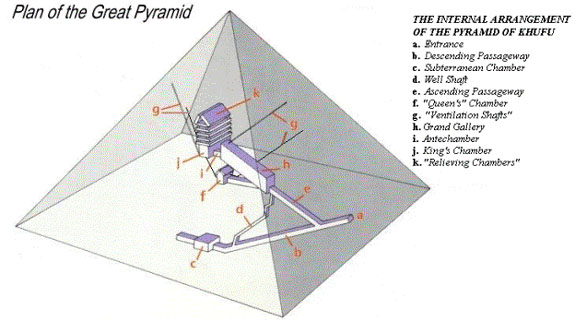
Serious scientific work on the Great Pyramid began in 1993, when we closed the pyramid for the first time for a full year. It was part of a plan to institute a rotational system at Giza, closing one pyramid a year while leaving the other two open, in order to balance conservation with tourism. During conservation it was found that the interior of the Great Pyramid had a humidity of 85 percent. Most of this was due to tourism, as each person inside the pyramid deposits approximately 20 grams of water through breathing. This water then becomes salt, which in 1993 covered the surface of the Grand Gallery; also, many cracks could be seen inside.

The pyramid needed to be cleaned, and a system to permanently lower humidity had to be developed. One idea was to clean the airshafts in the third chamber, the so-called King’s Chamber, and put machines inside of them to create a ventilation system. I talked to Rainer Stadelmann, the director of the German Archaeological Institute in Cairo at that time, who in turn arranged for a robotic expert, Rudolf Gantenbrink, to come and do work through the Institute. Gantenbrink designed a robot called Webwawat to investigate the airshafts in the third chamber. The robot was also sent inside the shafts in the so-called Queen’s Chamber, and made an intriguing find in the room’s two shafts. In the south shaft, Webwawat was stopped at 208 feet in front of a door or small stone with two copper handles. The left handle had lost a piece sometime in antiquity, which was lying about six feet in front of the door/stone. The northern shaft in the so-called Queen’s Chamber was blocked after approximately 27 feet. Gantenbrink published his information on the web at www.cheops.org. Gantenbrink’s work was the most in-depth work to be conducted on the shafts of the so-called Queen’s Chamber. The history of the investigation of these shafts begins in September 1872, when the British engineer Waynman Dixon discovered the openings of the north and south shafts of the Queen’s Chamber. Dixon pushed a wire through the joints of the masonry of the south wall, and realized there was a hollow space behind. He then chiseled through the wall to reveal the shaft. He looked for a shaft in the equivalent area of the north wall and found one. When he lit a candle and placed it in the southern shaft, there was a slight draft.
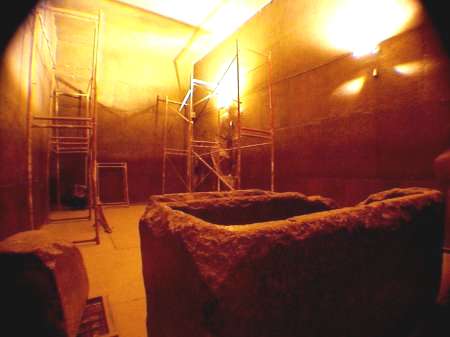
Kings Chamber - Great Pyramid - Copyright 1998 - Andrew Bayuk - All Rights Reserved

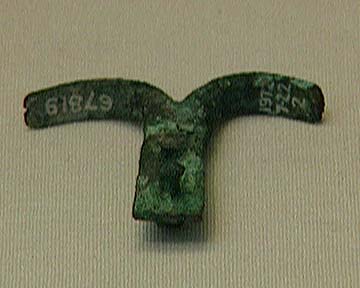
In the south shaft, Dixon and his associate James Grant found a small bronze hook. The north shaft yielded a granite ball and a portion of cedar-like wood. They became known as the Dixon Relics. Both sets of artifacts lay amongst rubble at the bottom of the sloping shaft. The relics were taken to England, recorded by astronomer Royal Scotland, and returned to Dixon – after which they disappeared. Report of the discovery of the relics was made in “Nature” December 26, 1872, including a drawing of the items.

In 1993 a search led to the discovery of the ball and hook in the British Museum, where they still are today. The piece of cedar-like wood remained missing until 2001, when it was traced at the Marischal Museum, Aberdeen. Although they are sure it is in their collection, they haven’t yet located it as they are in the process of moving

Gantenbrink’s exploration of the shaft in 1993 revealed a long piece of wood lying in the sloping portion of the shaft. Its cross-sectional area and general appearance were similar to the piece of wood found by Dixon. It is possible that the short piece of wood reported by Dixon simply broke from the larger piece. A modern metal pole found alongside the piece of wood supports this theory. No mention of the pole is made in Dixon’s reports, but it is now thought to have been lost when Dixon and his colleagues were “treasure-hunting” in the shaft. They probably broke the small piece of wood from the longer piece while they were manipulating the metal pole, but did not report it.
Some suggest that carbon dating the wood would allow accurate dating of the Pyramid because wood must have been left in the shaft when the Pyramid was constructed (given that the shaft was sealed) but I contend that this is not absolute. Wood may been placed in the shaft after construction via the shaft’s exit, if one exists.

Egyptologists have multiple explanations for these shafts. Some believe that they were used for ventilation, but this cannot be true as they do not open up to the outside. Others believe that they have an astronomical function; the southern shaft connected to the star Sirius, and the northern shaft linked to Minoris, Ursa, and Beta. Stadelmann believes that these shafts are not for ventilation, but are tunnels through which the king’s soul will rise to the stars that never darken.

I believe that the shafts from the so-called Queen’s Chamber likely have no function, as they were blocked from the inside. If they had a religious function, they should have been left open, as were the shafts of the third burial chamber (the King’s Chamber). Since these open outside of the pyramid, I believe that Khufu’s soul was meant to travel through them. The south shaft was intended for Khufu to use as the sun god Ra. The south shaft opens exactly between the two boat pits to the south of the Pyramid. Khufu would take the two boats and use them as solar boats – one for the day trip, one for the evening trip. The north shaft was made for the soul of Khufu as Horus to travel to the stars in order to emerge from them as the sun god.

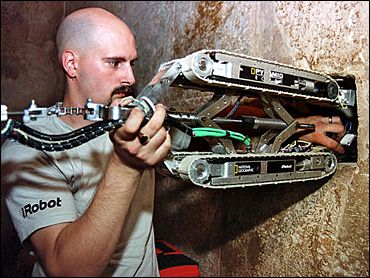
In order to understand the purpose of the shafts of the so-called Queen’s Chamber, more work had to be done. The German Institute in Cairo had the concession to the Great Pyramid, and I could see that they were not interested in completing the work on the shafts. It was impossible to sign the concession to Gantenbrink as he is an individual, and the antiquities law in Egypt only allows for concessions to be granted to institutions. So I decided that the Supreme Council of Antiquities (SCA) would do the work. I asked Tim Kelly of National Geographic Television to design a robot to probe the shafts, and I would head the expedition. I believed there was nothing behind this door at all but that it was very important for scholars and the public alike to know that there is nothing behind it. Archaeologists would know that even empty space is important.

National Geographic designed a robot and called it the Pyramid Rover, and the Permanent Committee of the SCA acknowledged the project as an Egyptian endeavor. The date for the television program was set for September 17. Before the show, I went to Hong Kong and Singapore to publicize it, and Mark Lehner went to Australia, India, and Spain right after the show. I, as well as my colleagues at National Geographic, wanted to be sure that we were honest and people were prepared for whatever find (or lack thereof) that we might make.
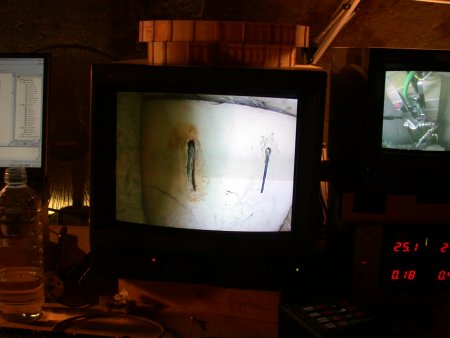
One of the main goals of the documentary was to show the public the evidence of the people who built the pyramids. I was to talk about tombs, show graffiti which names the work gangs that built the pyramids, and even go inside of the Step Pyramid of Djoser for the first time. The substructure of this pyramid consists of tunnels and passages and rooms with a total length of about three and a half miles. I believe that the interior was never shown in a film before, and that no living Egyptologist has entered it.

One day before the show, we found out by Altrosonic that the door in the southern shaft of the Great Pyramid is about six centimeters thick, which implied that there was something behind that door. We decided to drill a three-millimeter diameter hole in the door so we could send a camera behind it. In the last minute of the show, the camera was sent in, and I saw the second door 21 cm. behind the first door. It is not similar to the first in that it looks as if it is screening or covering something. There were also cracks all over the surface. I was so happy to see it, but I couldn’t understand why we had another door.

The show was well received all over the world by the public, and was rated “great” by Fox Television in the United States. Half a billion people in China watched the show. Newspapers all over the world covered it to a level that was never done for any television program before.

A few days after the show, we sent the robot into the northern shaft. Gantenbrink and Dixon both were only able to probe 27 feet because of a turn in the shaft. After further investigation, it seems that the turn was made in order to avoid intersecting the Grand Gallery, implying that the shafts were cut after the Grand Gallery’s construction. The Pyramid Rover went through this shaft and was stopped after a total of 208 feet, in front of another door with copper handles. It is in the exact same location as the first door in the southern shaft and is very similar to it. Behind this door there is likely another door exactly .70 feet away from the first, exactly like the south shaft.

The copper handles in the first doors in both the north and south shafts are similar to those on the canopic jar box of Tutankhamun at the Cairo Museum. The two copper handles were used for ropes to pull the canopic jars. The doors themselves are made of fine white limestone from Tura, and it seems as if their handles allowed them to be pulled inside the shafts, to the same location.
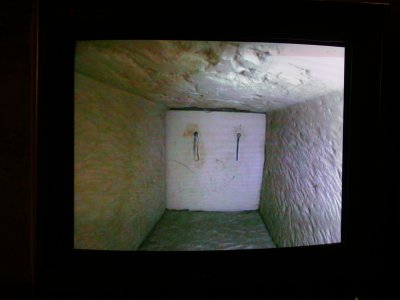
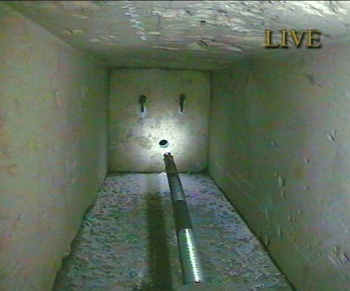
The probe attached to the robot gets ready to send its camera through a hole carefully drilled in the southern shaft "door".

The presence of these doors in the Great Pyramid creates many questions. One idea is that the doors are a challenge that the king must face before his travel into the afterlife. It is written in the Pyramid texts that the king will face bolts before he travels; perhaps this is a reference to the door’s copper handles. Yet if this is true, why is Khufu’s pyramid the only one with the doors? Also, why do they not exist in the shafts of the third chamber? Logically, they should be where the king’s body is buried. It is possible that these doors are evidence that Khufu’s burial chamber might be hidden somewhere inside of his pyramid.

However, these doors made the story about the Great Pyramid of Khufu more exciting, especially because the second door in the south shaft does not look like the first one and also the door in the north shaft is located in the same place as the one in the south shaft and appears similar to it with its two copper handles.
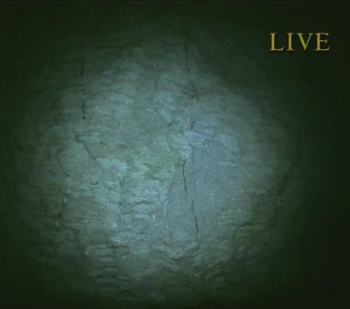
After the robot sent its probe through the handled slab in the southern shaft, another, more roughly hewn limestone slab, containing visible cracks was found.

We are planning to clean the south shaft from outside to learn if it does open to the outside. If it does, then it is possible that it was a symbolic door for the king to use in crossing to the Netherworld. If it is sealed, we have to return to the Westcar Papyri and read how Khufu was looking for the documents of the god Thoth to help him with the design of his pyramid. Only further research into the shafts can reveal their function, solving one of the many mysteries of the Great Pyramid.

0
Posted on 19:04 by The Wonders Of The World and filed under

In college, I learned a unique definition of communication; that communication "is the cement that holds society together". Without communication, the society will fall apart. For businesses, "Communication is a critical element in making successful business results." This was revealed by a Watson Wyatt Study.

We can also define communication as simple as the process of sending ideas and experiences from one person to another. When we communicate, our cognitive aspect is enhanced. Our minds work when we interact with people --- a simple greeting, retelling of wonderful activities shared or a debate.

Communication and relationship go everywhere and powerfully influence human activity. Much of what happens -- in our own lives, our communities, and world events alike -- counts on personal strengths and weaknesses in communicating, connecting, and interacting with others.

It is important that we are aware of communication practices. Communication Practices combines advantages of our two main ways of learning: organized education (such as classes, books, tutoring, or therapy), vs. learning by life experience. The goal of Communication Practices is to establish a discipline for cumulative development of better methods for teaching and learning certain interpersonal skills.

By "practices" we mean training methods which work entirely through everyday life and ordinary human interaction, and require no special equipment or other resources. Also, practices integrate training and life in exactly the same actions. Practices involve not only engaging in certain activities but also thinking and talking about those activities in particular ways.

The following are communication practices we can adapt to our everyday living:

* We can improve almost any relationship by finding something we honestly like or respect about the other person. But we miss opportunities to build these emotional bridges because we are attracted to the activity and motion of conflict.
• By practicing the physical movements, rhythms, and styles of others, we can understand them better, and also increase our own repertoire.

• Before engaging in any form of communication, decide what you want to say and work out a plan how to say it.

• A key component of effective communication is listening. Most communication involves more than one participant. You must hear the message someone is trying to convey to you to successfully communicate and give adequate feedback.

• An open mind is essential when communicating an idea, feeling or message. Remove all distractions around you so you can focus on the message someone is sending you.

The above practices can guide us in "going through the motions" of simple interactions, relationships and will greatly help in developing our memory.

Why Brain Training?


The brain needs care just like the body
New scientific research shows that we can improve the health and function of our brains with the right mental workouts. In a study funded by the National Institute of Health, scientists found that memory, reasoning and processing speed can be improved by brain training. Moreover, they found that cognitive improvements persisted for at least five years!